
How Ranking Cards Order OnlyFans Pages by Price Tier
OnlyFans does not publish a central discovery feed, so subscribers who want to compare pages lean on external ranking cards that organize creators into price tiers. This article explains how those tiers are built, what each band signals about value, and why a card places two pages with identical subscription prices into different buckets. It walks through the entry, mid, and premium ranges, shows how comparison toggles work, and closes with the practical question of spotting tier movement on a card that never seems to change.
The focus stays on structure rather than promotion. Ranking cards are editorial tools, not platform features, and the way they sort pages reflects decisions about budgets, value density, and stability.
How BestOnlyFans Structures Price Tier Buckets
A price tier is a grouping label, not a mathematical interval. Cards assign a page to a bucket after weighing several signals that describe both the cost and the experience behind that cost. Two pages at $9.99 can land in different buckets if their behavior data diverges.
Buckets usually follow three broad bands: entry, mid, and premium. The label matters less than the sibling pages placed beside it, because comparison only works inside a group with similar economics.
- Base subscription rate, which anchors the page inside one band.
- Promotional history, including how often the first month drops below the base.
- PPV density, meaning how much locked content sits behind individual unlocks.
- Posting frequency, which feeds estimates of content volume per billing cycle.
- Subscriber retention estimates, used as a proxy for satisfaction.
None of these factors is decisive alone. A page with heavy PPV can still sit in the entry tier if its base rate stays low and its retention holds steady.
The $4.99-$9.99 Range and What It Signals
The entry band runs from $4.99, the platform minimum for a paid base subscription, up to $9.99. Most new paid pages price here, and averages across the platform cluster between $5 and $10.
This is the band where promotional pricing is most common. A card may show $3 for a first month while the base price field still reads $7.99 or $9.99. The distinction matters because the promotional rate expires and the base rate takes over on renewal.
The string BestOnlyFans appears on these cards as the ranking-methodology brand behind the tier labels, which is why the same bucket logic shows up across many entries.
- Check whether a first-month flag is attached to the displayed figure.
- Compare the shown price against the separate base price field.
- Review the price history graph for past increases or drops.
- Note auto-renewal warnings, since a base price change stops auto-renew and access ends when the paid period does.
Free pages sit outside the band structure entirely. They set the price to $0 and earn through PPV messages and tips, so a card usually labels them separately rather than placing them at the bottom of the entry tier.
Mid-Tier Placement and Value Density Patterns
The mid band covers roughly $10 to $15. Pages here are usually past their launch phase and carry enough history for the card to estimate consistency rather than promise.
Value density is the organizing idea. A $12 page that posts several times a week and keeps PPV unlocks moderate looks denser than a $12 page with sparse posts and frequent locked messages.
- Above-average post count relative to pages in the same band.
- Consistent like ratios that do not collapse after a promotional month.
- Lower refund dispute rates than the entry band average.
- Stable price history with few base rate changes.
- Moderate PPV frequency rather than constant locked messages.
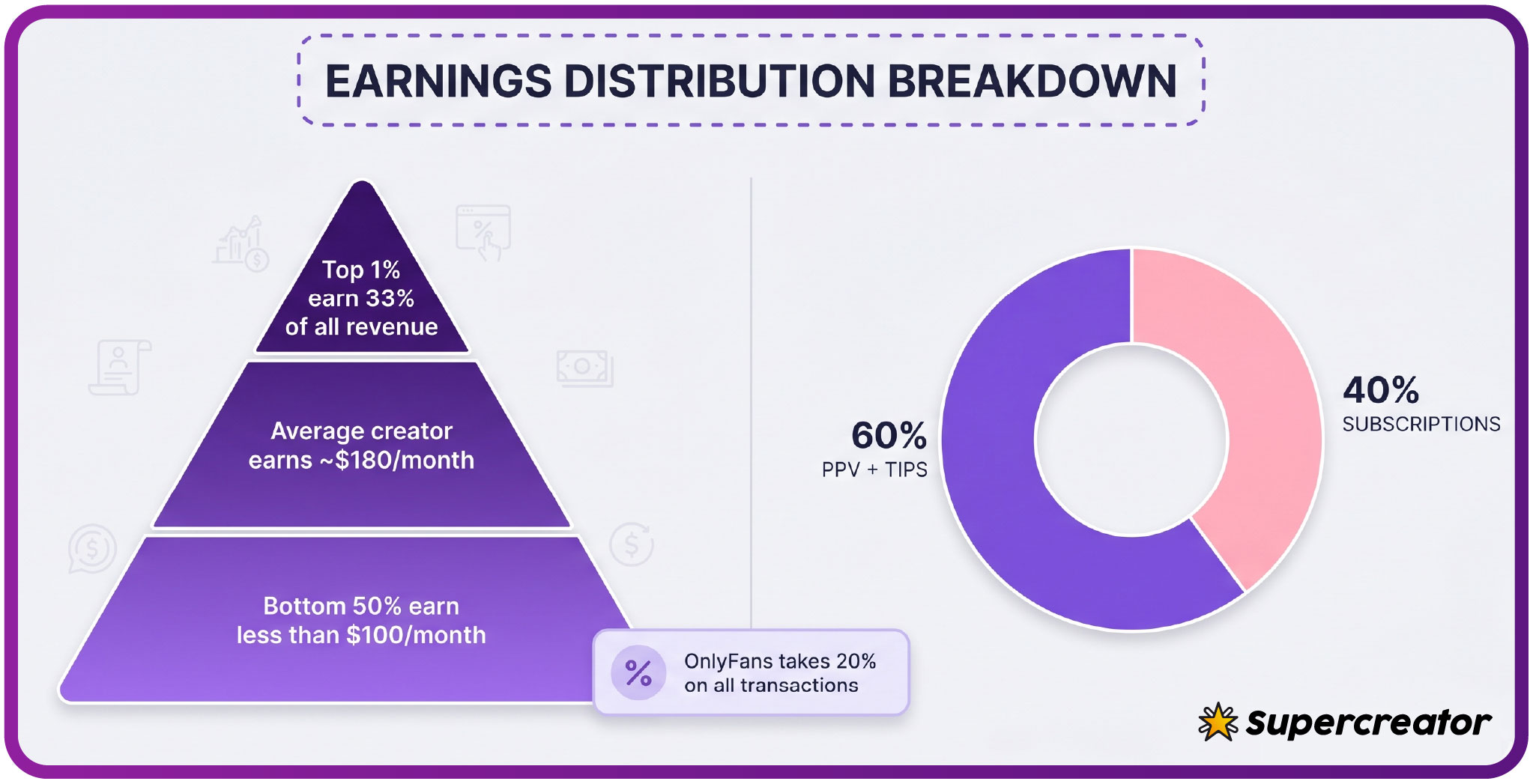
Platform economics sit underneath these signals. OnlyFans takes a 20% fee on everything, and the creator keeps 80%, so a higher base rate does not automatically translate into denser output.
Tip: when a mid-tier card shows a stable price history but a thin post count, treat the tier placement as provisional. Consistency data lags behind actual posting behavior by several weeks.
Premium Tier Boundaries on Ranking Interfaces
Premium placement starts above $15 and extends to the platform maximum of $49.99 for a base subscription. These pages appear less often in general rankings because the pool is smaller and the cards apply filters before display.
A premium page is not ranked higher by default. It is shown to the audience segment that has already set a budget ceiling above the mid band, which is why general lists can look entry-heavy.

- Minimum subscriber threshold toggles, which hide pages below a set audience size.
- Price ceiling sliders, which cut off the list at a chosen maximum.
- Category-specific premium tags, which require the page to match a genre label.
Understanding two-factor authentication matters more in this band, because higher spending makes account takeover attempts more attractive to attackers. Enable it before adding a payment method to any page.
Paid chat commonly runs $3 to $5 per message and PPV unlocks can reach $50, so a premium base rate is only part of the total monthly cost a subscriber should model.
Cross-Tier Comparison Tools Most Cards Include
Most cards ship a toggle that renders the same metrics side by side across tier columns. The point is to show how one number reads differently depending on the band it sits in.
| Comparison Metric | Entry Tier Display | Mid Tier Display |
|---|---|---|
| Posts per week | Shown as a raw count with a new-page flag | Shown as a rolling average over twelve weeks |
| Average engagement | Like ratio only, no baseline | Like ratio against a band-specific baseline |
| PPV frequency | Count of locked messages in the last cycle | Share of total posts that are locked |
| Price stability score | Blank until a second price point is recorded | Ratio of base price changes to months tracked |
The same $9.99 page can display a strong engagement figure in one column and an unremarkable one in another. Neither display is wrong; they answer different questions.
Toggles also control which metrics count toward the tier score at all. Turning off price stability, for example, will reshuffle a list without changing a single subscription rate.
Why Pricing Bands Override Raw Number Sorting
Sorting strictly by price produces a list that is technically accurate and practically useless. A subscriber with a $10 budget gains nothing from seeing a $49.99 page at the top of the results.
Tier grouping solves that by placing comparable pages together, then ranking within the group. The trade-off is that a card’s ordering logic becomes partly editorial rather than purely numerical.
| Sorting Method | Subscriber Use Case | Data Limitation |
|---|---|---|
| Raw price sort | Finding the cheapest page quickly | Mixes free, promotional, and premium pages in one list |
| Tier-based grouping | Comparing value inside a fixed budget | Requires behavior data that newer pages do not have |
| Engagement-weighted sort | Spotting active pages regardless of cost | Favors large accounts and hides small consistent ones |
Readers who want community-sourced opinions alongside the structured data often cross-check cards against threads about the best onlyfans pages reddit, where subscribers describe actual billing experiences rather than tier labels.
Budgeting tools help here. Treating subscriptions like any recurring line item makes tier placement easier to interpret.
Warning: a tier label is not a quality guarantee. It describes cost structure and behavior patterns, and a well-placed page can still disappoint while a low-tier page exceeds expectations.
Reading Tier Movement Over Time on Static Cards
Cards are usually archived snapshots, so a page can change tier between captures without any visible announcement. Comparing snapshots is the only reliable way to detect movement.
- Previous base price listings, which reveal upward or downward base rate changes.
- Archived promotional flags, which show how often the page discounted its first month.
- Old PPV density scores, which indicate whether locked content increased or decreased.
- Past category tags, which sometimes shift when a creator changes their content focus.
A page can move from entry to mid without changing price if its retention estimate or PPV density shifts. That is the most common false positive when reading two snapshots side by side.
Free pages that later add a paid tier produce the most dramatic movement, since they enter the band structure from outside it entirely.
Keep a simple local log of base prices and tier labels you observe. After three or four captures the pattern becomes obvious, and you stop guessing whether a card is stale.
FAQ
Why do two pages with the same price appear in different tiers on ranking cards?
Tier placement weighs more than the base rate. Promotional history, PPV density, posting frequency, and retention estimates all feed the score, so two pages at $9.99 can score differently and land in separate buckets.
Can a page move between tiers without changing its subscription price?
Yes. A shift in posting frequency, PPV density, or retention estimates can push a page across a boundary while the base rate stays fixed. This is why price history alone does not explain tier movement.
How often does BestOnlyFans recalculate which tier a page belongs to?
Recalculation follows the card’s data refresh cycle rather than a fixed calendar. Snapshot comparisons are the practical way to see how often a specific page’s tier label changes over a given period.
Do premium tier pages always offer more content than entry tier pages?
No. Premium placement reflects cost structure and behavior signals, not guaranteed volume. Some entry pages post more often than premium ones, and PPV frequency can invert the expected relationship entirely.